
PNLE Table of Specifications
The PNLE TOS, explained.
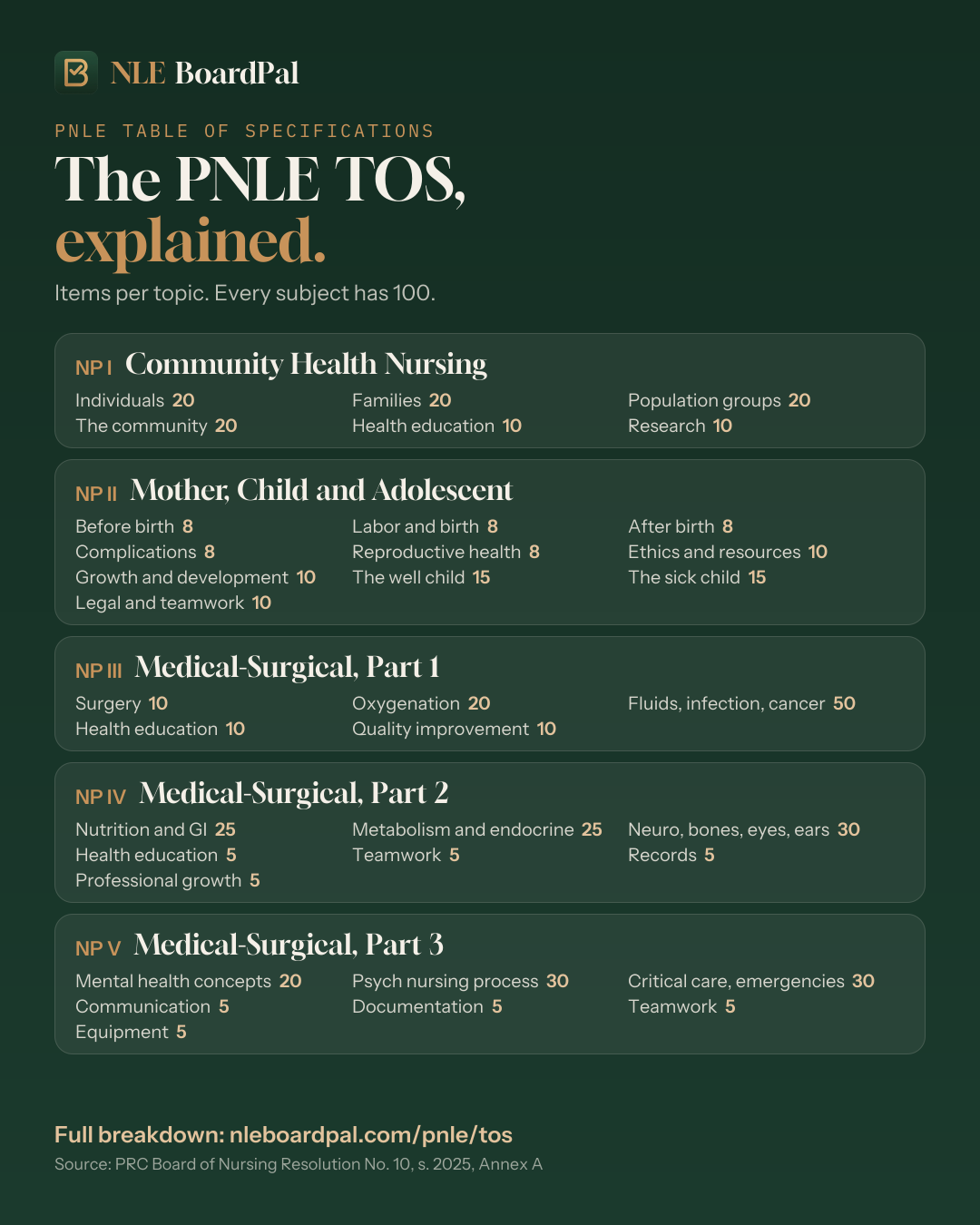
What each subject covers and how many of its 100 items each topic gets, from PRC's official tables
- 5subjects
- 100items each
- 75%general average to pass
- 60%lowest allowed in any subject
New since November 2025. This is the Enhanced TOS from Board of Nursing Resolution No. 10, s. 2025, replacing the 2006 and 2017 tables. Tap any topic to see what PRC lists under it and where to study it.
Nursing Practice I
Community Health Nursing
Care of Individuals, Families, Population Groups and Community (Community Health Nursing)
Part A: Care in the community80 items
Care of individuals in the community setting20 items
What PRC lists
- Clients with non-communicable diseases: risk factors, prevention and control (10 items)
- Clients with communicable diseases: control, eradication and elimination (10 items)
Study it on BoardPal
Non-Communicable Diseases · Communicable Diseases: Basic Concepts · Tuberculosis · Leprosy · Mosquito-Borne Diseases · Integumentary-Related CDs · Neuro-Related CDs · Common Infectious Diseases Summary
Care of families in the community20 items
What PRC lists
- Care of normal families (10 items)
- Care of families at risk (10 items)
Study it on BoardPal
Family Nursing Process · Care of Families (Normal & At-Risk)
Care of population groups in the community20 items
What PRC lists
- Care of population groups with other health priorities (20 items)
Study it on BoardPal
Care of Population Groups with Other Health Priorities · Maternal & Child Health (MCH) Programs · Expanded Program on Immunization (EPI) · Nutrition Programs · Integrated Management of Childhood Illness (IMCI) · Community Mental Health Program
Care of the community20 items
What PRC lists
- The Philippine health care delivery system and the Department of Health
- Universal Health Care and the Sustainable Development Goals
- Primary health care and primary care
- Community assessment, diagnosis, planning, intervention and evaluation
- Epidemiology, vital statistics and demography
- Care of the community during disaster
- School nursing, and occupational health and safety nursing
- Community organizing and participatory action research
- Recording, reporting and information technology in the community setting
- Referral system
Study it on BoardPal
PH Health Care Delivery System / DOH · Universal Health Care (UHC) & SDGs · Primary Health Care (PHC) · Community Health Nursing Process · Epidemiology, Vital Statistics & Demography · Disaster Nursing in the Community · School & Occupational Health Nursing · Recording, Reporting & Health Information · Referral System · Sanitation & Environmental Health · Laws: Nursing Practice & Health Workforce · Laws: Disease Reporting & Control · Laws: Health Financing & Insurance · Laws: Maternal, Child & Reproductive Health · Laws: NCD, Environmental, Occupational & Nutrition
Part B: Health education and research20 items
Tested inside community situations that also check evidence-based practice, laws and ethics, communication, records, teamwork, leadership, technology in care and the nursing core values.
Health education for individuals, families, population groups and the community10 items
Study it on BoardPal
Health Education & Research Utilization in CHN
Use of research in the care of individuals, families, population groups and the community10 items
Study it on BoardPal
Health Education & Research Utilization in CHN · Nursing Research
How the 100 items test you
- 10Remembering
- 10Understanding
- 50Applying
- 10Analyzing
- 10Evaluating
- 10Creating
Nursing Practice II
Mother, Child and Adolescent
Care of Mother and Adolescent (Well Clients), At Risk or With Problems; Human Growth and Development; Care of the Well and At-Risk Neonate, Infant, Toddler, Pre-school, School-age Child and Adolescent (Acute and Chronic)
Part A: Mother and adolescent50 items
Care of the mother before birth8 items
What PRC lists
- Normal pregnancy: signs, length, trimesters, hygiene, physiologic adaptations
- Emotional and psychosocial adaptations
- Dimensions of maternal development
- Discomforts of pregnancy and relief measures
- Prenatal management and the goals of comprehensive prenatal assessment
Study it on BoardPal
Normal Pregnancy
Care of the mother during labor and birth8 items
What PRC lists
- Theories of labor; premonitory, true and false signs of labor
- Physiologic alterations in labor; the 5 Ps; stages and duration of labor
- Partograph and Leopold's maneuvers
- Cardinal movements of the fetus
- Natural childbirth and psychoprophylaxis
- Essential newborn care
Study it on BoardPal
Normal Labor & Delivery
Care of the mother following birth8 items
What PRC lists
- Normal puerperium: physiological changes, psychological support, early puerperal care
- Essential objectives of nursing care in the puerperium
- Family planning methods: natural, temporary and permanent
Study it on BoardPal
Normal Puerperium · Family Planning Methods
Care of the mother with complications of childbearing8 items
What PRC lists
- During pregnancy: risk factors and diagnostic tests
- Pregnancy-induced hypertension, gestational diabetes, hyperemesis gravidarum, placenta previa, abortion, abruptio placentae, iron deficiency anemia, folic acid deficiency
- Pre-existing and co-existing diseases: managing high-risk conditions, government programs, BEmONC and CEmONC
- During labor: preterm and precipitate labor, dystocia, preterm PROM, uterine rupture, fetal distress, IUFD, hemorrhage, cord prolapse, vena caval syndrome, amniotic fluid embolism, operative obstetrics, analgesia and anesthesia
- After birth: postpartum hemorrhage, puerperal sepsis, mastitis, thrombophlebitis, cystitis, uterine prolapse, postpartal psychosis, paternal postpartal depression, reproductive loss and grieving
Study it on BoardPal
Complications During Pregnancy · Complications During Labor · Postpartum Complications
Care of male and female clients with reproductive health problems8 items
What PRC lists
- The menstrual cycle
- Fertilization, genetic disorders and fertility assessment
- Alternatives to childbirth
Study it on BoardPal
Female & Male Reproductive Systems · Fertilization, Genetics & Fertility
Ethico-moral issues and management of resources10 items
Study it on BoardPal
Ethico-Moral & Management in Maternal Care
Part B: Growth, development and the child50 items
Human growth and development10 items
What PRC lists
- Theories of growth and development: Freud, Piaget, Bandura, Erikson and Bowlby
Study it on BoardPal
Theories of Growth & Development · Developmental Milestones
Care of the well neonate, infant, toddler, pre-schooler, school-age child and adolescent15 items
What PRC lists
- Health promotion, disease prevention, restoration, maintenance and rehabilitation
- Safety, communication and immunization
Study it on BoardPal
Health Promotion & Disease Prevention (Pedia) · Adolescent Health · Expanded Program on Immunization (EPI)
Care of the at-risk and sick neonate, infant, toddler, pre-schooler, school-age child and adolescent15 items
Part of the toddler list is missing from PRC's scanned PDF: the page jumps from the toddler heading to "poisoning, cerebral palsy, child abuse".
What PRC lists
- Neonate and infant: prematurity, postmaturity, SGA, LGA, hyperbilirubinemia, meconium aspiration syndrome, fetal alcohol syndrome, sepsis
- Congenital anomalies: autism spectrum disorder, VSD, tetralogy of Fallot, clubfoot, cleft lip and palate, imperforate anus, Hirschsprung disease, hydrocephalus
- Toddler (list cut off in the scan), then: poisoning, cerebral palsy, child abuse
- Pre-schooler: acute lymphocytic leukemia, hemophilia, Wilms' tumor, asthma
- School-age: type 1 diabetes, rheumatic fever, dengue fever and dengue hemorrhagic fever
- Adolescent: sexually transmitted diseases with higher cancer risk (HPV), anxiety and depression
Study it on BoardPal
Pediatric Cardiovascular Disorders · Pediatric Respiratory Disorders · Pediatric Gastrointestinal Disorders · Pediatric Hematologic & Oncologic Disorders · Pediatric Neurologic Disorders · Pediatric Renal Disorders · Pediatric Integumentary & Musculoskeletal Disorders · Integrated Management of Childhood Illness (IMCI)
Legal aspects, collaboration and teamwork10 items
Study it on BoardPal
Legal Principles, Collaboration & Teamwork in Pedia
How the 100 items test you
- 15Remembering
- 15Understanding
- 24Applying
- 25Analyzing
- 11Evaluating
- 10Creating
Nursing Practice III
Medical-Surgical, Part 1
Care of Clients with Problems in Surgery, Oxygenation, Fluid and Electrolytes, Infectious, Inflammatory and Immunologic Response, Cellular Aberrations (Acute and Chronic)
Part A: Safe patient care80 items
Care of patients undergoing surgery10 items
What PRC lists
- Pre-operative, intra-operative and post-operative care
Study it on BoardPal
Classification of Surgery · Pre-operative Phase · Intra-operative Phase · Post-operative Phase
Care of patients with problems in oxygenation20 items
What PRC lists
- Lower airways: ventilation, gas-exchange and perfusion disorders
- Upper airways
- Perfusion problems
Study it on BoardPal
Upper Airway Disorders · Bronchial Asthma · COPD · ARDS · Pneumonia (CAP, HAP, VAP) · Pneumothorax, Hemothorax & Chest Tubes · Pulmonary Embolism & Pulmonary Hypertension · Heart Anatomy & ECG Basics · Acute Coronary Syndrome (ACS) · Peripheral Vascular Diseases & Hypertension · Hematologic Disorders
Fluids and acid-base; infectious, inflammatory and immunologic disorders; cellular aberrations50 items
PRC prints 20, 16 and 14 items beside these three topics, but the numbers sit out of line with the topic names, so the split between them is not clear. Together they get 50 items.
What PRC lists
- Fluid and electrolyte imbalances: dehydration, cellular dehydration, sodium and potassium imbalances
- Acid-base imbalances: regulation, analysis of arterial blood gases, respiratory and metabolic acidosis and alkalosis
- Urinary elimination imbalances
- Infectious: hepatitis, HIV-AIDS, COVID, STDs
- Inflammatory: Guillain-Barre, Crohn's disease, ulcerative colitis
- Immunologic: anaphylactic shock, systemic lupus erythematosus, multiple sclerosis, acute glomerulonephritis, transplant rejection
- Cellular aberrations (cancer): breast, uterus, prostate; blood (ALL, AML); lungs; liver and colon
Study it on BoardPal
IV Fluids · Electrolyte Imbalances · Acid-Base Balance & ABG · Acute Kidney Injury (AKI) · Chronic Kidney Disease (CKD) · Dialysis (Hemodialysis & Peritoneal) · Infectious Disorders · Inflammatory Bowel & Neuro-Inflammatory Disorders · Immunologic & Connective Tissue Disorders · Basic Concepts in Cancer · Cancer Treatment Modalities · Oncologic Emergencies · Site-Specific Cancers
Part B: Health education and quality improvement20 items
Health education10 items
What PRC lists
- Disease process, diet, medications and exercise
Study it on BoardPal
Health Education & Quality Improvement
Quality improvement10 items
What PRC lists
- Medications, staffing, falls, research, and policies and procedures
Study it on BoardPal
Health Education & Quality Improvement · Leadership & Management
How the 100 items test you
- 10Remembering
- 20Understanding
- 50Applying
- 14Analyzing
- 6Evaluating
- 0Creating
Nursing Practice IV
Medical-Surgical, Part 2
Care of Clients with Problems in Nutrition and Gastro-Intestinal, Metabolism and Endocrine, Perception and Coordination (Acute and Chronic)
Part A: Safe patient care80 items
Nutrition and gastrointestinal disturbances25 items
PRC splits these items into 5 that test knowledge and 20 that test patient care.
What PRC lists
- Malnutrition, including obesity
- Oral and esophageal disorders
- Absorption and elimination: intestinal motility, malabsorption syndrome, structural and obstructive bowel disorders
Study it on BoardPal
Malnutrition · Oral & Esophageal / Gastric Disorders · GI Absorption & Elimination · Ostomies
Metabolism and endocrine25 items
PRC splits these items into 5 that test knowledge and 20 that test patient care.
What PRC lists
- Metabolic disorders of the liver, biliary tract and pancreas (diabetes mellitus)
- Endocrine hypo-function and hyper-function: thyroid, parathyroid, adrenal and pituitary glands
Study it on BoardPal
Hepatobiliary Disorders · Diabetes Mellitus · Endocrine Emergencies Summary · Thyroid Disorders · Parathyroid Disorders · Adrenal Gland Disorders · Pituitary Gland Disorders · ADH Disorders
Perception and coordination disturbances30 items
PRC splits these items into 5 that test knowledge and 25 that test patient care.
What PRC lists
- Neurologic: multiple sclerosis, Parkinson's disease, myasthenia gravis, cerebrovascular accidents, Alzheimer disease and dementia, traumatic lesions, neuropathies, peripheral nerve and spinal cord diseases
- Musculoskeletal: trauma, metabolic bone disorders, infections, occupation-related disorders, casts, splints and braces
- Vision: cataract, glaucoma, retinal detachment, ocular and orbital trauma, infections and inflammation, effects of systemic disease
- Hearing and balance: conditions of the external, middle and inner ear
Study it on BoardPal
Neuroanatomy & Assessment Basics · Increased Intracranial Pressure (IICP) · Cerebrovascular Accident (Stroke) · Parkinson's Disease · Multiple Sclerosis (MS) · Myasthenia Gravis (MG) · Guillain-Barré Syndrome (GBS) · Autonomic Dysreflexia · Alzheimer's Disease & Dementia · Seizure Disorders · Spinal Cord Injuries (SCI) · Peripheral Neuropathies · Amyotrophic Lateral Sclerosis (ALS) · Musculoskeletal Review & Interventions · Musculoskeletal Trauma · Metabolic Bone Disorders · Inflammatory & Infectious Bone/Joint Disorders · Spinal & Other MSK Conditions · Eye Anatomy, Assessment & Refractive Disorders · Glaucoma & Cataract · Retinal Detachment & Macular Degeneration · Other Eye Conditions & Surgery Care · Ear Anatomy, Assessment & Hearing Loss · Ear Disorders & Surgery Care
- Free questions: Neurologic Nursing
- Cram sheet: Neuro A — Assessment, ICP, Stroke & Seizures
- Cram sheet: Neuro B — Parkinson's, MS, Myasthenia & GBS
- Cram sheet: Neuro C — Spinal Cord Injury & Peripheral Nerves
- Cram sheet: Musculoskeletal — Fractures, Casts, Traction & Joints
- Cram sheet: Sensory — Eye and Ear Disorders
Part B: Education, teamwork, records and growth20 items
Health education5 items
Study it on BoardPal
Health Education & Quality Improvement
Collaboration and teamwork5 items
Study it on BoardPal
Leadership & Management
Reporting and recording5 items
Study it on BoardPal
Documentation & Professional Development
Personal and professional development5 items
Study it on BoardPal
Documentation & Professional Development · Professional Adjustment & Nursing Jurisprudence
How the 100 items test you
- 10Remembering
- 10Understanding
- 33Applying
- 31Analyzing
- 13Evaluating
- 3Creating
Nursing Practice V
Medical-Surgical, Part 3
Care of Clients with Maladaptive Patterns of Behavior (Acute and Chronic); Care of Clients with Life-Threatening Conditions, Acutely Ill/Multi-Organ Problems, High Acuity and Emergency Situations
Part A: Safe patient care80 items
Concepts of mental health and mental illness20 items
What PRC lists
- The state of mental health in the Philippines and the mental health care delivery system (5 items)
- Psychobiologic bases of behavior: neuroscience, patterns of human behavior, global and regional perspectives
- Therapeutic models: psychoanalytic, developmental (Erikson), interpersonal (Sullivan, Peplau), cognitive (Piaget, Beck), cognitive therapy, stress models (5 items)
- Understanding stress: acute and long-term effects, general adaptation syndrome, measuring stress and coping
- Psychopathology: psychoses, anxiety, mood, personality, cognitive, eating, sexual and substance-related disorders, disorders of childhood and adolescence, domestic violence (10 items)
Study it on BoardPal
Foundations of Mental Health Nursing · Therapeutic & Stress Models · Anxiety & Anxiety-Related Disorders · Trauma-Related Disorders · Mood Disorders · Schizophrenia & Other Psychoses · Personality Disorders · Eating Disorders · Substance Use Disorders · Cognitive & Other Psychiatric Disorders
The nursing process in psychiatric and mental health care30 items
What PRC lists
- Assessment: subjective and objective data (5 items)
- Nursing diagnosis: NANDA taxonomy, DSM-IV and DSM-5 (5 items)
- The nurse-client relationship: orientation, working and termination stages (5 items)
- Mental Health Gap Action Programme (mhGAP): depression, PTSD, psychosis, epilepsy and seizures, intellectual disability, suicide (5 items)
- Treatment modalities: ECT, complementary and alternative therapy, psychotherapies, behavioral, cognitive, milieu, art, dance and music, and attitude therapies, psychopharmacology (antipsychotics, anxiolytics, antidepressants, lithium and mood stabilizers), nutrition and diet therapy (5 items)
- Evaluation of care: outcome-based (5 items)
Study it on BoardPal
Psychiatric Assessment & Symptomatology · Therapeutic Communication & Relationship · Crisis Intervention · Somatic & Behavioral Therapies · Psychopharmacology
Acute biologic crisis: life-threatening and emergency situations30 items
What PRC lists
- Altered ventilatory function: pulmonary embolism, ARDS, acute lung injury, respiratory failure, ventilator-associated pneumonia, respiratory pandemics, pulmonary hypertension, pneumothorax (5 items)
- Altered tissue perfusion: acute ischemic heart disease, heart failure, cardiogenic shock, coronary artery disease, hypertensive crisis, cardiomyopathy, arrhythmias (5 items)
- Altered elimination: acute GI bleeding, intra-abdominal hypertension, abdominal compartment syndrome, liver failure, acute pancreatitis, diabetic ketoacidosis, hyperglycemia, hyperosmolar non-ketotic acidosis, acute renal failure (5 items)
- Altered perception: traumatic alterations, acute ischemic stroke, spinal cord injury, seizures (5 items)
- Multi-system problems: shock, SIRS, multi-organ dysfunction syndrome (5 items)
- High acuity and emergencies: airway, breathing, circulation; head injury and stroke; heat, submersion, poisoning, drowning, diving and lightning injuries (5 items)
Study it on BoardPal
Altered Ventilatory Function · Altered Tissue Perfusion · Altered Elimination · Altered Perception · Multi-System Problems (Shock & Sepsis) · High Acuity & Emergency Situations
Part B: Communication, records, teamwork, equipment20 items
Nurse-client communication5 items
What PRC lists
- Components, modes and types of therapeutic communication
Study it on BoardPal
Therapeutic Communication & Relationship
Documentation in psychiatric nursing practice5 items
What PRC lists
- Elements of documentation and methods of charting
Study it on BoardPal
Documentation & Professional Development
Collaboration and teamwork5 items
Study it on BoardPal
Collaboration & Communication in Critical Care
Equipment for acute, high-acuity and emergency care5 items
What PRC lists
- CPR machine, ventilator, dialysis machine, ABG analysis machine, TPN
Study it on BoardPal
Critical Care Equipment
How the 100 items test you
- 14Remembering
- 18Understanding
- 46Applying
- 17Analyzing
- 5Evaluating
- 0Creating
The six thinking levels
PRC sorts every item by the kind of thinking it asks for
Remembering
Recall a fact: a normal value, a schedule, a law.
Understanding
Explain why something happens or what it means.
Applying
Use what you know on a patient situation.
Analyzing
Sort the cues to find what matters most.
Evaluating
Judge which action is best or whether care worked.
Creating
Put together a plan of care for a new situation.
Take it with you
Questions students ask
What is the PNLE TOS?+
The Table of Specifications is the Board of Nursing's official list of what each PNLE subject covers, how many of its 100 items each topic gets, and how many items test each thinking level. PRC requires every exam item to come from it.
Is this the TOS for the coming PNLE?+
It is the TOS adopted in Board of Nursing Resolution No. 10, s. 2025, which applies from the November 2025 exam onward and stays in force until the Board issues a new one. We last compared this page with PRC's PDF on 1 November 2026.
How many items is the PNLE?+
500 items: 5 Nursing Practice subjects of 100 items each.
What score do I need to pass?+
A general average of at least 75%, with no subject rated below 60% (Republic Act 9173, the Philippine Nursing Act of 2002, Section 15).
What changed from the old TOS?+
It replaces Resolution No. 18 (s. 2006) and Resolution No. 11 (s. 2017). It is aligned with the Philippine Qualifications Framework (Level 6), and for each subject it sets how many items test each thinking level, from Remembering to Creating.
Where can I download the official TOS?+
From the PRC website. The links to the Resolution and to Annex A (the tables themselves) are in the Sources section of this page.
Sources
- Board of Nursing Resolution No. 10, s. 2025 (PRC, PDF)
- Annex A: the Enhanced Table of Specifications (PRC, PDF)
Numbers copied from PRC's tables as printed. Last compared with PRC's PDF on 1 November 2026.
Study the whole TOS, day by day.
Every topic on a calendar to your exam day, and 10 free questions a day.
Start free